Industry · United Arab Emirates
ITAD for Data Centres, Hosting & Colocation
In a hosting environment the drives are the liability and the chassis is metal. Inventory has to happen at drive level or it has not happened.
Why does data centre decommissioning need drive-level inventory?
A single 2U server can hold twenty-four drives, so a certificate saying the server was destroyed says nothing about any of them. Data Sentry inventories at drive level, reconciles against your CMDB export on site before the crew leaves, and issues a per-drive Certificate of Destruction you can pass to your own customers.
What Makes Data Centres & Hosting Different
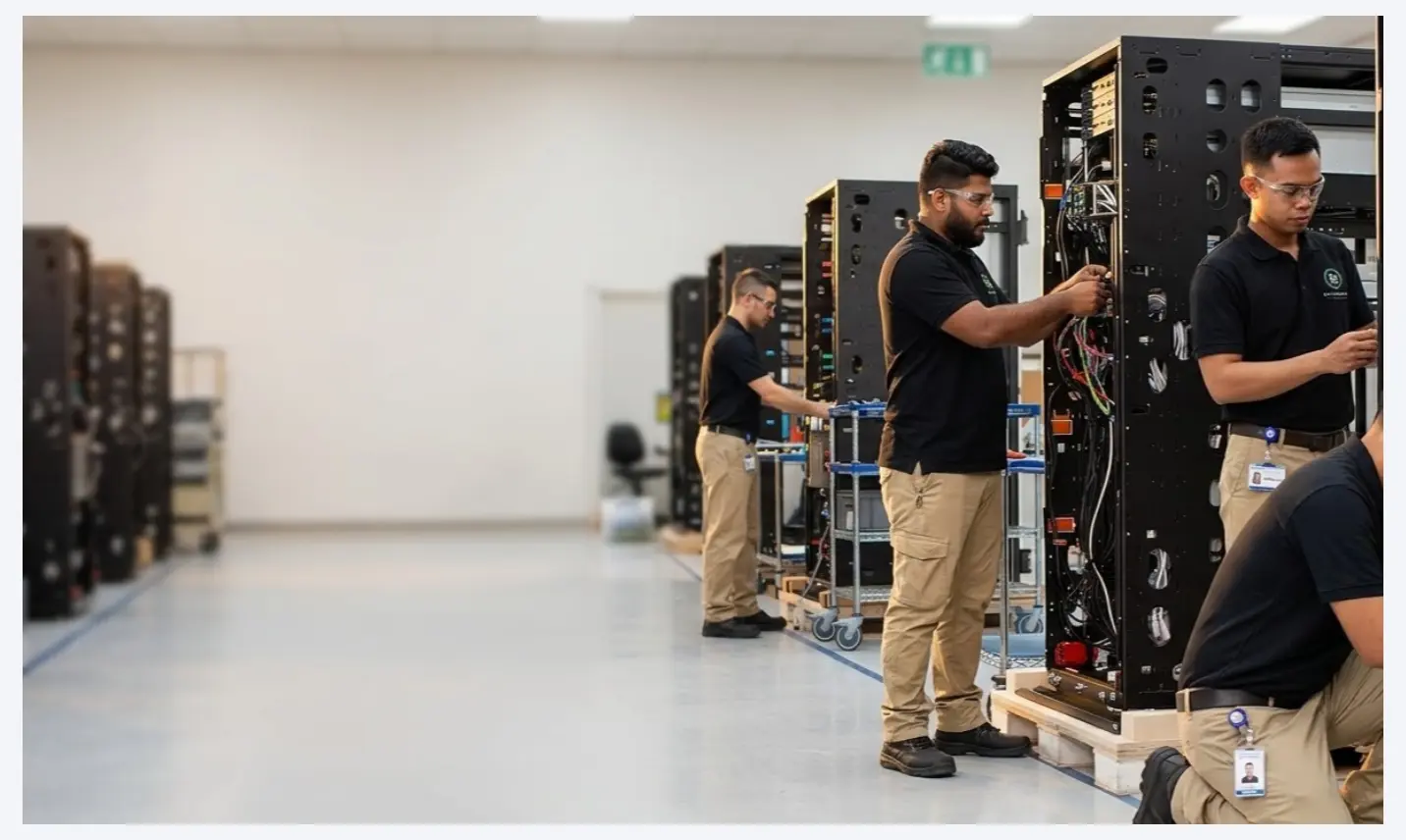
A data centre decommission is the highest-density disposal there is, in every sense — value per square metre, data per rack, and consequences per mistake. It is also the engagement where the standard ITAD process most often proves inadequate, because chassis-level inventory is meaningless here. A 2U server may hold twenty-four drives, and the certificate that says the server was destroyed says nothing useful about any of them.
For a hosting or colocation provider there is a further dimension: much of the data on those drives belongs to your customers rather than to you. The destruction record is not just something you file, it is something you owe to them, and contractually you may be obliged to produce it. That makes drive-level serial capture a deliverable rather than a nicety.
The physical work is its own discipline. De-racking a live hall means working alongside equipment that must stay up, with a power-down window that is fixed, cable management that has accumulated for a decade, and a hard boundary between what leaves and what stays. Nearly every decommission that goes wrong goes wrong on that boundary, not on the lifting.
What Is Actually on the Hardware
The categories below are what we find on data centres & hosting equipment in practice — not a theoretical risk list.
- Customer data on drives you host but do not own
- Storage array drives holding fragmented but recoverable data
- Hypervisor and management plane credentials
- Backup appliances and snapshot repositories
- Network configuration, firewall rules and topology
- Out-of-band management controllers with cached credentials
Equipment We Handle
Everything with storage in it gets inventoried, whether or not it sits on your IT asset register.
- Rack servers, blades and chassis
- SAN and NAS storage arrays and JBODs
- Enterprise SSDs, NVMe and spinning drives at volume
- Top-of-rack switches, directors and optical transceivers
- Rack PDUs, UPS systems and battery strings
- Cabinets, containment, cable trays and structured cabling
The Rules You Are Answering To
Named obligations rather than vague appeals to "compliance". These are the instruments an auditor or regulator will actually reference.
Federal Decree-Law No. 45 of 2021 (UAE PDPL)
Where you process personal data on behalf of customers, you are a processor with your own obligations — including demonstrable secure disposal.
Customer contractual data handling obligations
Hosting and colocation contracts routinely require evidence of secure destruction on decommission, independent of statutory duties.
DIFC and ADGM data protection regimes
Where customers are DIFC or ADGM entities, their regime effectively passes through to you as their processor.
Federal Law No. 12 of 2018 on Integrated Waste Management
Rack and infrastructure material is a controlled waste stream, and data centre operators report on it under sustainability commitments.
Deeper reading: UAE PDPL compliance for IT asset disposal →
How We Work With Data Centres & Hosting Clients
Decommissions are planned in writing before anything is unracked. We agree rack elevations, the exact boundary between what is leaving and what stays live, the power-down window, and whether drives are pulled on site or the chassis travel populated. Drives are captured at serial level — not chassis level — and reconciled against your own asset or CMDB export, with any discrepancy raised before we leave rather than discovered later. High-value components are assessed for remarketing where you permit it, because modern CPUs, ECC memory at volume, enterprise SSDs and optics carry real value that is destroyed by treating a rack as scrap. Everything else goes to material recovery. You receive a drive-level Certificate of Destruction suitable for passing to your own customers.
What you receive
- Drive-level inventory reconciled to your CMDB export
- Written boundary between removed and live equipment
- De-racking, cable removal and cage-out included
- Certificate of Destruction per drive, passable to customers
- Component-level remarketing valuation where permitted
- Discrepancy resolution before the crew leaves site
Services Behind This
Data Destruction
Shredding, degaussing and verified erasure, certified per serial.
ITAD Solutions
End-to-end disposition with audit trail and value recovery.
Auditing & Inventory
Serial-level capture reconciled to your asset register.
Secure Logistics
Tracked, chain-of-custody transport from your floor to our facility.
Data Centres & Hosting: Questions We Get Asked
Why does drive-level inventory matter more than chassis-level?
Because a 2U server can hold twenty-four drives, and a certificate saying the server was destroyed tells you nothing about any of them. In a hosting environment the drives are the liability and the chassis is metal. If the inventory is not at drive level, it has not answered the question anyone will ask.
Our customers require destruction evidence from us. Can we pass yours on?
Yes, that is what it is designed for. The certificate names each drive serial and the destruction method, so you can discharge your contractual obligation to a customer with our document rather than with an assurance in your own words.
Can you de-rack in a live hall without touching production?
Yes, and the critical input is a written boundary — precisely which racks, U positions and cable runs are in scope. Almost every decommission that goes wrong goes wrong on an ambiguous boundary, not on the lifting. We agree it in writing and work to it.
Is there real value in decommissioned data centre hardware?
Considerable, and it is the category most often given away. Modern CPUs, ECC memory at volume, enterprise SSDs, GPUs and optics carry substantial component value. Where you permit remarketing after verified sanitisation, the recovery is typically many times a scrap valuation.
What happens if the drive count does not match our records?
We raise it before the crew leaves site. A discrepancy found on the day is an operational question; the same discrepancy found three weeks later is an incident. That is why reconciliation happens on site against your export rather than afterwards.
Related Sectors
Oil, Gas & Energy
Permit-to-work compliant collection of control system and site IT, with OT-aware destruction.
Banking & Finance
Witnessed destruction and serial-level evidence for DIFC, ADGM and onshore licensed firms.
Free Zone Companies
Gate passes and outbound permits handled across every major UAE free zone.
Scope Your Data Centres & Hosting Disposal
Send the asset list, the constraints and the deadline. You get a written offer, an agreed destruction method per media type, and documentation built for the audit you will eventually face.