Industry · United Arab Emirates
IT Asset Disposition for Banking & Financial Services
For a regulated financial firm, disposal is an evidence exercise. The hardware value is real — but the document that matters is the one naming each destroyed serial.
How should a UAE bank dispose of retired IT equipment?
A regulated financial firm needs evidence, not a receipt. Data Sentry inventories every device at serial level in front of your representative, destroys drives — on your premises and witnessed, if your policy requires — and issues a Certificate of Destruction naming each serial. That is what satisfies a DIFC, ADGM, PDPL or PCI DSS review.
What Makes Banking & Finance Different
A bank retiring four hundred branch workstations and a boutique asset manager retiring forty laptops have almost nothing in common operationally, and exactly the same problem in principle: every one of those machines held customer identity documents, account records, transaction history and correspondence, and the firm has to be able to demonstrate what happened to that data. Not assert it. Demonstrate it, with a document that names a specific device.
This is where most disposal arrangements quietly fail an audit. A recycling receipt confirms that a quantity of equipment was collected. It does not confirm that the drive in asset number 4471 was destroyed, and that distinction is the entire question a regulator or an internal audit function will ask. We work backwards from that question: the inventory is taken at serial level in front of your representative, custody is signed at handover, and the Certificate of Destruction names each device and the method used on it.
The second thing financial firms consistently underestimate is scope. The workstation refresh gets managed properly and the rest does not — the decommissioned branch server, the retired backup tapes in the archive room, the ATM or kiosk hardware, the trading floor rigs, the multifunction printers with internal drives that spooled every scanned account opening form for six years. We inventory the whole estate rather than the part that is easy to remember.
What Is Actually on the Hardware
The categories below are what we find on banking & finance equipment in practice — not a theoretical risk list.
- Customer KYC files, passport and Emirates ID scans
- Account numbers, statements and transaction histories
- Cardholder data on payment and terminal hardware
- Credit files, loan applications and underwriting notes
- Internal correspondence and privileged deal material
- Cached credentials and network configuration on endpoints
Equipment We Handle
Everything with storage in it gets inventoried, whether or not it sits on your IT asset register.
- Branch workstations, teller terminals and cash handling PCs
- Trading desk rigs and multi-monitor workstations
- Server rooms, storage arrays and backup appliances
- Backup tapes, archive media and encrypted drives
- ATM, kiosk and self-service hardware
- Multifunction printers and scanners with internal drives
The Rules You Are Answering To
Named obligations rather than vague appeals to "compliance". These are the instruments an auditor or regulator will actually reference.
DIFC Data Protection Law No. 5 of 2020
Firms registered in DIFC operate under their own regime, supervised by the DIFC Commissioner of Data Protection, sitting alongside rather than beneath the federal law.
ADGM Data Protection Regulations 2021
ADGM-licensed entities on Al Maryah Island answer to the ADGM Office of Data Protection, with its own registration and accountability requirements.
Federal Decree-Law No. 45 of 2021 (UAE PDPL)
The federal baseline for onshore entities. Personal data on a disposed device remains the controller's responsibility until it is destroyed.
Federal Law No. 12 of 2018 on Integrated Waste Management
Responsibility for waste stays with the entity that generated it, nationally and inside free zones. Handing equipment to an unlicensed collector does not transfer liability.
PCI DSS media destruction requirements
Where cardholder data is in scope, the standard requires media to be rendered unrecoverable and the destruction to be documented — which is a certificate, not a receipt.
Deeper reading: UAE PDPL compliance for IT asset disposal →
How We Work With Banking & Finance Clients
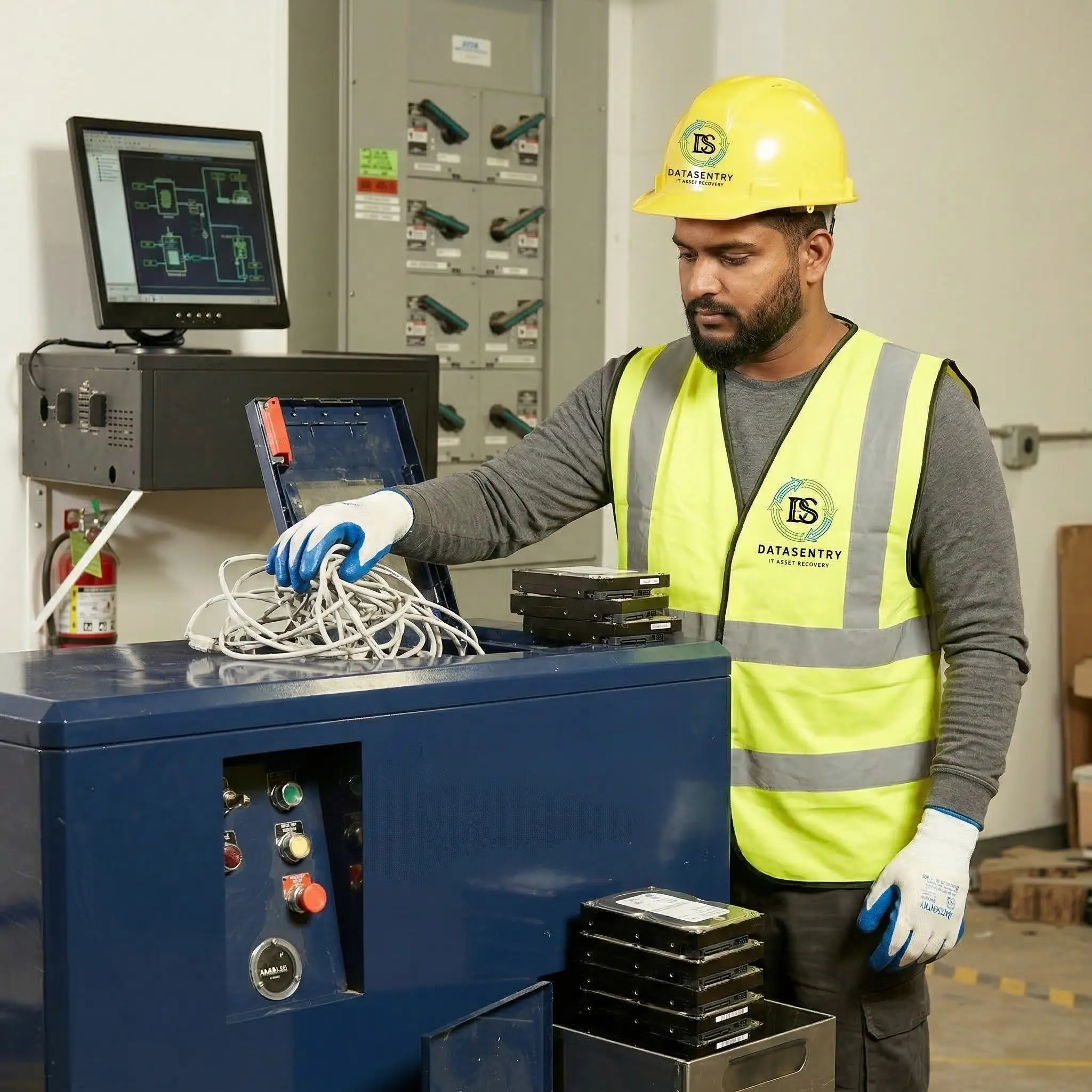
Financial engagements start with scope rather than with a vehicle. We agree the asset list, the destruction method per media type and who signs what, before any date is set. Collections are typically out of hours and in unmarked vehicles, because a scrap truck in a bank loading bay is not a neutral event for staff or other tenants. Inventory is captured on site at serial level and countersigned before anything leaves the floor. Where your policy requires it — and for most regulated clients it does — drives are destroyed on your premises with your compliance officer present, so the media never leaves the building intact. Documentation follows within an agreed window, and we retain a matching record so a certificate can be re-issued if an audit lands two years later.
What you receive
- Serial-level asset register countersigned on site
- Signed chain-of-custody record from floor to facility
- Certificate of Destruction naming every device and method
- Witnessed on-site destruction where policy requires it
- Recycling report for ESG and sustainability reporting
- Retained records so certificates can be re-issued for audit
Services Behind This
Data Destruction
Shredding, degaussing and verified erasure, certified per serial.
ITAD Solutions
End-to-end disposition with audit trail and value recovery.
Auditing & Inventory
Serial-level capture reconciled to your asset register.
Secure Logistics
Tracked, chain-of-custody transport from your floor to our facility.
Banking & Finance: Questions We Get Asked
Our drives are already encrypted. Is destruction still necessary?
Yes. Encryption is a control, not a disposal method. Keys get escrowed, cipher choices age badly, and an auditor asking what happened to the data will not accept "it was encrypted" as evidence of destruction. Encrypted media is destroyed rather than trusted, and it appears on the certificate like any other device.
Can our compliance officer witness the destruction?
Yes, and for most regulated clients we recommend it. Drives can be destroyed on your premises with your representative present, or you can attend destruction at our facility. Either way the certificate records the method, the date and each serial number.
What happens to backup tapes and older archive media?
Tapes are degaussed or shredded according to format, and both are documented on the same certificate as the disks. Archive media is the single most commonly forgotten category in financial disposals — it sits in a room nobody has opened for years and holds the oldest, most complete records in the business.
Do you handle multifunction printers? Our IT team says they are not IT assets.
They almost always are. A branch MFP holds an internal drive that has spooled every scanned account opening form, statement and identity document passed through it. Treating printers as furniture is one of the more common ways customer data leaves a bank unnoticed.
How long do you keep records of a destruction?
We retain the matching record so a certificate can be reproduced if an audit or regulatory review asks for it later, which is frequently well after the disposal. Confirm your required retention period at the scoping stage and we will align to it.
Related Sectors
Data Centres & Hosting
Drive-level inventory and certification for colocation, hosting and enterprise data halls.
Government & Public Sector
Serial and tag-level reconciliation to your fixed asset register, with witnessed destruction.
Free Zone Companies
Gate passes and outbound permits handled across every major UAE free zone.
Scope Your Banking & Finance Disposal
Send the asset list, the constraints and the deadline. You get a written offer, an agreed destruction method per media type, and documentation built for the audit you will eventually face.